ABOUT
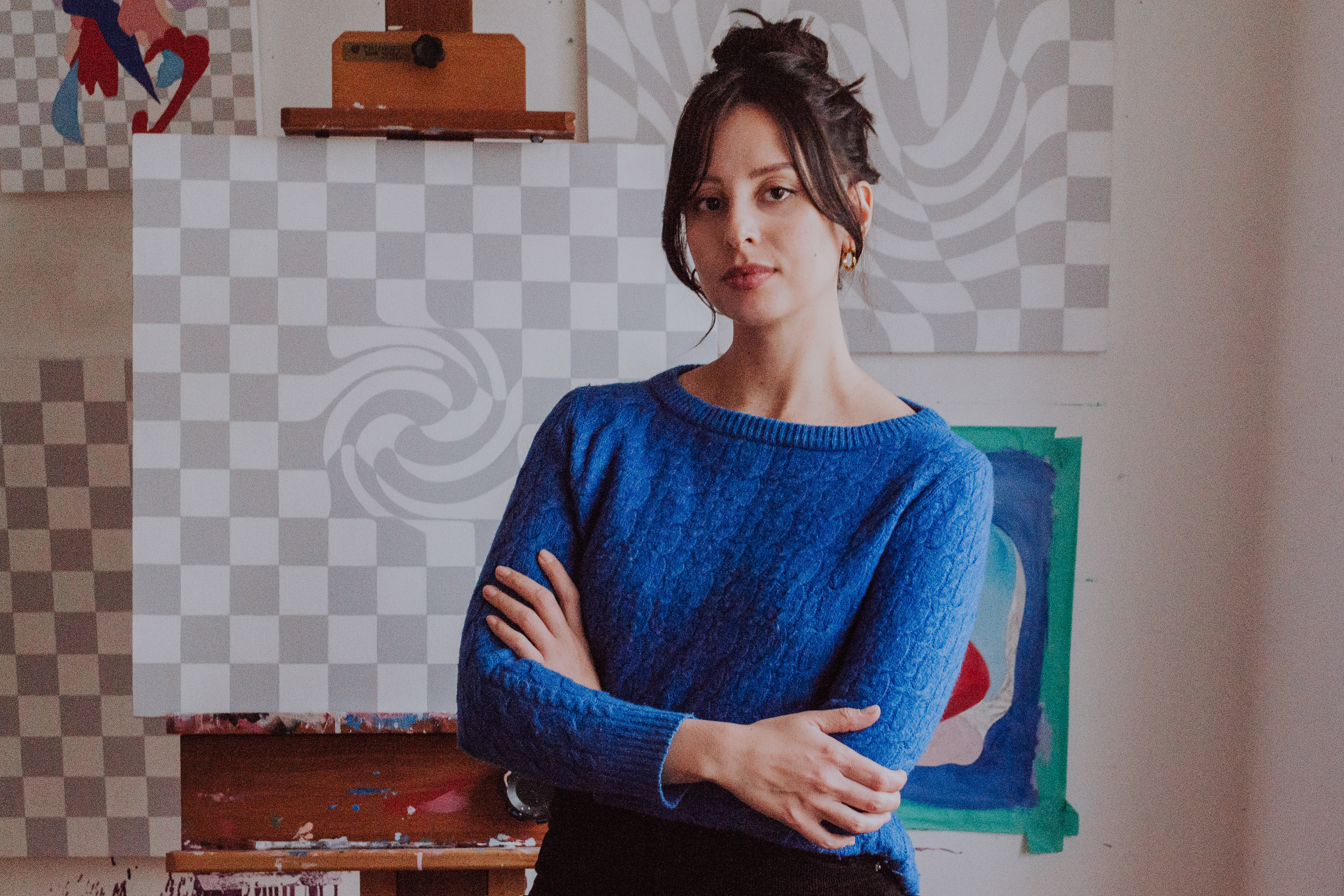
Luciana Gnoatto (Curitiba, Brazil, 1990) is a Brazilian visual artist whose practice investigates the formation, transformation, and perception of images in an environment increasingly shaped by digital technologies. Working primarily through painting, she explores the relationship between virtual image-making processes and their material translation into physical space.
Drawing from image-editing software, photography, personal archives, and contemporary visual culture, Gnoatto examines the structures that underpin images before they become fully recognizable. Grids, layers, distortions, cropping tools, and transparency patterns frequently appear in her work as visual and conceptual devices, migrating from the digital interface into painting. Her practice is particularly interested in moments of emergence, when forms oscillate between abstraction and representation, appearing and dissolving simultaneously.
Gnoatto holds a Bachelor's degree in Design from the Federal University of Technology – Paraná (UTFPR) and completed an academic exchange at Hochschule für Gestaltung Offenbach (HfG), Germany. Recent solo exhibitions include Camada Um (Sala de Arte do Canto, São Paulo, 2025) and Plano de Fundo (Asa BASA, Curitiba, 2024). Her work has also been featured in exhibitions including INTRANET (2024), Extrapolação (2024), entre-lugar (2025), and Lembro de Onde Nunca Estive (2025). In 2026, she was selected for the Fall into Focus residency program at Arteles Creative Center, Finland.
STATEMENT
My practice investigates how images are formed, transformed, and perceived in an environment increasingly mediated by digital technologies.
Drawing from image-editing software, photography, painting, and personal archives, I explore the structures that underlie contemporary visual culture. Transparency grids, cropping tools, distortions, and layers become recurring elements that migrate from the digital interface into physical space.
Rather than treating the digital image as immaterial, I am interested in its translation into matter, how pixels, edits, and virtual gestures can acquire texture, weight, and presence through painting. My work often moves between abstraction and figuration, examining the tension between visibility and concealment, permanence and transformation.
Through this process, I seek to reveal the hidden frameworks that shape how images are constructed, remembered, and understood.